Every Time Your Parent Picks Up an Unknown Call, You Hold Your Breath
You've tried telling them. They said you're being dramatic. Then they mentioned a "nice man from Microsoft" called to fix their computer, and your stomach dropped. You Googled "how to protect elderly parents from scams" and found 400 pages of government advisories, a $300/year identity monitoring subscription, and a lot of articles that explain what scams look like but don't give your parent a single thing to do when the phone rings.
The Elder Scam Shield is a Scam Interception System — not another article about fraud, but a printable kit of scripts, physical checklists, and family protocols that catches scams before your parent sends the money. A one-sheet taped to the fridge. A code word that defeats AI voice cloning. Refusal scripts that let your parent hang up without feeling rude. Designed for the adult child who's running out of time to protect a parent who won't listen to lectures.
Seniors lost $3.4 billion to fraud last year in the US alone — and most cases go unreported because victims are too ashamed to tell their families. Scammers now use AI to clone your voice from a 30-second social media clip. Your parent gets a call that sounds exactly like their grandchild, begging for bail money. Intelligence doesn't protect against this. Politeness keeps them on the line.
Works for families in the US, UK, Canada, Australia, and New Zealand — with region-specific reporting guides and scam examples for each country.
Is This For You?
This guide is for you — the adult son or daughter who:
- Has a parent over 60 who still answers the phone for unknown numbers
- Has tried to explain "phishing" and been told they're being paranoid
- Worries about a parent's retirement savings being wiped out in a single phone call
- Doesn't live close enough to monitor things daily
- Wants a solution that works with their parent, not against them
What's Inside the Scam Interception System
The "Refrigerator One-Sheet"
Your parent won't read a 300-page FBI report, and they won't bookmark an AARP article. But they will glance at a single large-print page taped next to the phone. The One-Sheet has the 3 Never Rules and the family emergency number — no reading glasses required, no WiFi needed. It turns abstract warnings into a physical object that's there when the phone rings.
The Family Code Word System
AI can clone a voice from a 30-second social media clip. When your parent gets a call that sounds exactly like their grandchild begging for bail money, "trust your instincts" isn't a defence. A pre-agreed code word is. If the caller can't say it, it's a scammer — no matter how real they sound. Takes 10 minutes to set up. Defeats the most sophisticated impersonation technology available.
Word-for-Word Refusal Scripts
Your parent was raised in a generation where you don't hang up on people — and scammers weaponize that politeness. The FBI calls it the "Politeness Trap." Telling your parent to "just hang up" doesn't work because it violates how they were raised. These scripts give them a dignified exit: "I have a family rule that I discuss all financial requests with my daughter first." Polite, firm, rehearsable. No argument, no rudeness.
The Tech Audit Checklist
Government sites say "adjust your phone settings." This checklist shows exactly how — step-by-step for iPhone and Android to enable "Silence Unknown Callers," install an ad blocker, set up spam filters, and block the remote-access apps scammers install to drain bank accounts in real time. Designed so you can lock down your parent's devices in one afternoon visit.
Scam Red Flag Cards
Most scam advice tells you "be vigilant." These visual reference cards tell you what to actually look for — on the phone (grandparent calls, IRS threats, tech support pop-ups), online (romance scam patterns, fake government texts), and on the device itself (remote access software, crypto apps, suspicious payment apps that weren't there last month).
Conversation Script Cards
The hardest part isn't understanding scams — it's getting your parent to accept help without triggering the "you think I'm stupid" shutdown. These are word-for-word scripts for you, the adult child: the proactive setup conversation, the suspected romance scam intervention, and the finance talk. Framed as partnership, not control — because when a child corrects a parent, it's a power struggle, but when a guide says "the FBI recommends this," it's neutral advice.
The Family Financial Safety Agreement
When you tell your parent "don't send money to strangers," it's a lecture. When both of you sign a one-page agreement that says "any withdrawal over $1,000 gets a second pair of eyes," it's a family protocol. Non-confrontational, written down, and effective — because the agreement does the enforcing, not you.
First 24 Hours Emergency Action Plan
If a scam does get through, the first few hours determine whether you recover the money or lose it permanently. This step-by-step response covers account freezes, email security, malware scans, authority reporting, and a ready-to-send bank dispute letter — so you're not frantically Googling "what to do if parent got scammed" at 10 PM on a Sunday.
Monthly Protection Routine
New scam vectors emerge every month — AI voice cloning didn't exist two years ago. This printable recurring checklist has weekly (5 min), monthly (20 min), and quarterly (30 min) checks: review recent calls, check for new app installs, update the code word, verify financial contacts. Scam protection as a habit, not a one-time setup.
Regional Reporting Guides
Scam advice written for the US doesn't help if your parent lives in the UK, Canada, Australia, or New Zealand. Each country has different authorities, reporting processes, and consumer protection rules. The guide covers all five — FBI/FTC, Action Fraud, CAFC, Scamwatch, Netsafe — with the specific contacts and procedures for each.
What you'll download:
- The Elder Scam Shield Guide (PDF, 8 chapters)
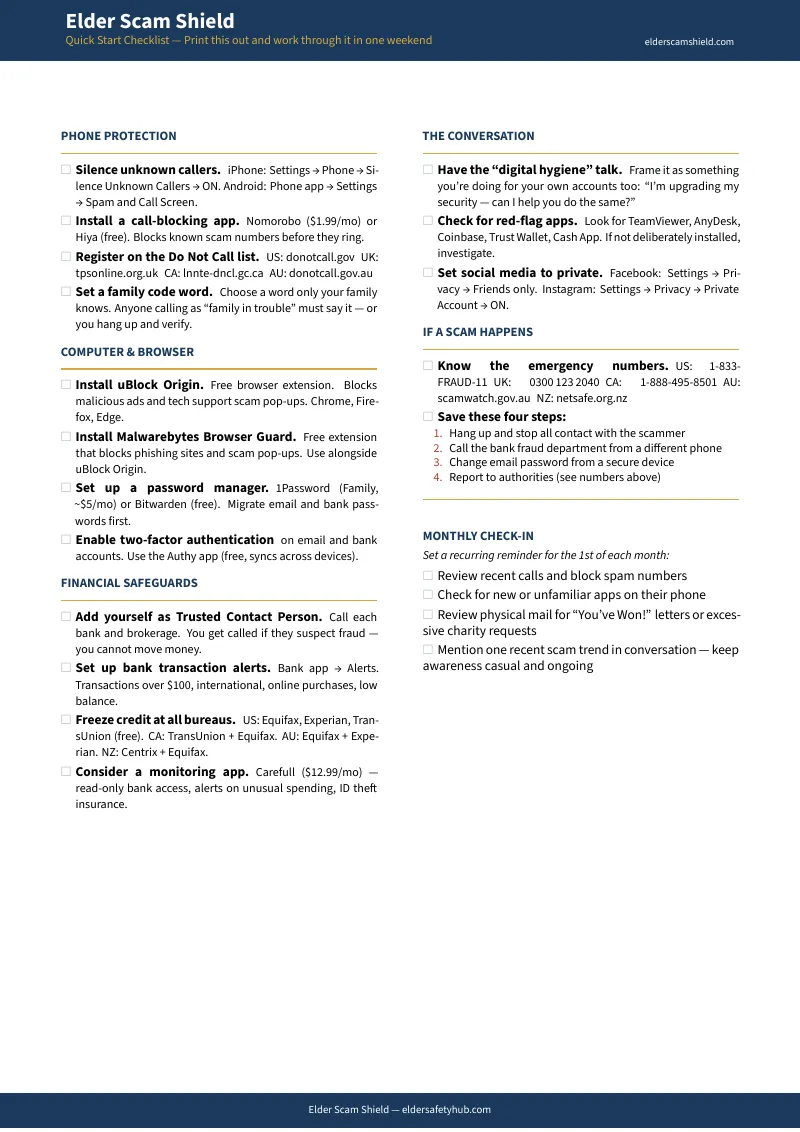
- Quick Start Checklist (printable, 1 page)
- Refrigerator One-Sheet (large-print, 1 page)
- Scam Red Flag Cards (printable, 6 cards)
- Family Financial Safety Agreement (printable, 1 page)
- Conversation Script Cards (printable, 2 pages)
- Emergency Action Plan (printable, 2 pages)
- Monthly Protection Routine (printable, 1 page)
Why Not Just Use Free Resources?
Free scam education exists everywhere. Here's what it consistently fails to do:
- AARP and government sites educate. They don't equip. The AARP Fraud Watch Network has hundreds of articles. The FTC "Pass It On" campaign encourages seniors to "start a conversation." But none of them give you a printable one-sheet to tape to the fridge, a rehearsable script your parent can use when the phone rings, or a step-by-step device lockdown checklist. They explain what scams look like. They don't provide the tools to stop one.
- Identity monitoring catches theft. It can't stop voluntary transfers. LifeLock and Aura cost $300+/year and they're excellent at detecting when someone opens a credit card in your parent's name. But when your parent voluntarily wires $50,000 to a romance scammer — which is how the most devastating losses happen — the monitoring software can't intervene. It watches the door. It can't stop someone from opening it.
- Etsy printables raise awareness. They don't intercept. A $5 "Senior Scam Awareness Poster" gives your parent something to glance at. It doesn't give them a script to say when the phone rings, a code word to verify a caller's identity, or a family agreement that puts a checkpoint on large withdrawals. Awareness is not the same as interception.
- Nothing is designed for the adult child. Almost every free resource talks directly to the senior. But you're the one doing the research at midnight, trying to lock down a phone over FaceTime, and bringing up scams at the dinner table without starting an argument. This system is built for you — with conversation scripts, device setup guides, and family protocols that solve the interpersonal problem, not just the information problem.
Free tools give you information. The Elder Scam Shield gives you a Scam Interception System.
Built on Official Guidance
Every recommendation is based on published guidance from the FBI's Internet Crime Complaint Center (IC3), the FTC, Action Fraud UK, and the Australian Competition and Consumer Commission. We distilled hundreds of pages of government advisories into a printable system your parent will actually use.
This is NOT a tech manual. It's not about installing antivirus software or configuring firewalls. It's a human system — scripts, checklists, and agreements that work even if your parent can barely use email.
— The Cheapest Insurance Policy You'll Ever Buy
Compare it to:
- Identity theft monitoring: $300+/year (and it can't stop your parent from voluntarily wiring money)
- The average elder fraud loss: $35,000+
- The guilt of wishing you'd done something sooner
30-day money-back guarantee. If this doesn't give you peace of mind, you pay nothing.
Every day without a system is another day your parent picks up the phone unprotected. Get the Elder Scam Shield now — print it tonight, tape it to the fridge tomorrow morning.