Stop Relying on Facility Brochures. Start Auditing Them.
The Assisted Living Guide is built on the Placement Protection System — the same structured evaluation methodology that Geriatric Care Managers charge $150/hour to walk you through, distilled into a printable toolkit you can use yourself. Facility scorecards, contract red-flag checklists, tour question scripts, ADL assessments, financial comparison worksheets, and sibling alignment tools — everything you need to evaluate assisted living options independently, expose hidden fees before you sign, and avoid the placement mistakes that cost families thousands. No referral commissions. No lead generation. No phone spam.
Here's what nobody warns you about: One day your parent is managing. The next day they've fallen, or wandered, or the neighbor calls to say the stove was left on again — and suddenly you're the one who has to figure out what comes next. You Google "assisted living." Every website wants your phone number. Within 24 hours, you're fielding calls from "free advisors" who earn $4,000 in referral commissions from the facilities they recommend. The brochures show chandeliers and dining rooms. Nobody mentions the night-shift staffing ratio, the non-refundable community fee, or the contract clause that lets them evict your parent when the dementia progresses. You're supposed to make a $70,000-per-year decision — and every "free" resource is working for the other side.
Covers the US, UK, Canada, Australia, and New Zealand — with country-specific regulatory guides, financial frameworks, and inspection report lookups for each system.
Is This For You?
This guide is for you — the adult son or daughter who:
- Got the call from the hospital saying "Mom can't go home alone" — and now you have 48 hours to find a safe place with zero preparation
- Toured a facility that looked beautiful but couldn't answer your question about night-shift staffing or what happens when your parent's needs escalate
- Entered your phone number on a "free" placement site and got 15 sales calls before dinner — because you didn't know those sites earn $4,000 per referral from the facilities they recommend
- Has a sibling who thinks Mom is "fine" because they visit once a month and she puts on a brave face — and you need objective data to end the argument
- Is terrified of choosing the wrong facility — one where your parent is sedated to save staffing costs, or where a vague contract clause lets them evict her when care needs increase
- Wants to sit down with a structured system and compare facilities on safety, staffing, cost, and contract terms — not on who has the nicest lobby
You know something needs to change. The "free" advisors work for the facilities. The government websites are data dumps without guidance. The books are 300 pages of prose when you need a checklist. You need the Placement Protection System — not another sales pitch disguised as help.
What's Inside the Placement Protection System
- ADL/IADL Assessment Worksheet — Because "Is it time?" is the wrong question to argue about at the kitchen table. This is the same clinical framework geriatric professionals use to determine readiness. Score your parent's ability to manage bathing, dressing, medications, finances, and meal preparation — and turn the emotional debate into a documented, objective answer you can share with siblings and doctors.
- Facility Comparison Scorecard — Because your gut tells you Facility A "felt nice," but your gut can't measure night-shift staffing ratios. A weighted scoring matrix across five dimensions: care capabilities (30%), financial transparency (25%), staff engagement (20%), physical environment (15%), and lifestyle/dining (10%). Print one per facility, complete it during the tour, and compare numbers instead of impressions.
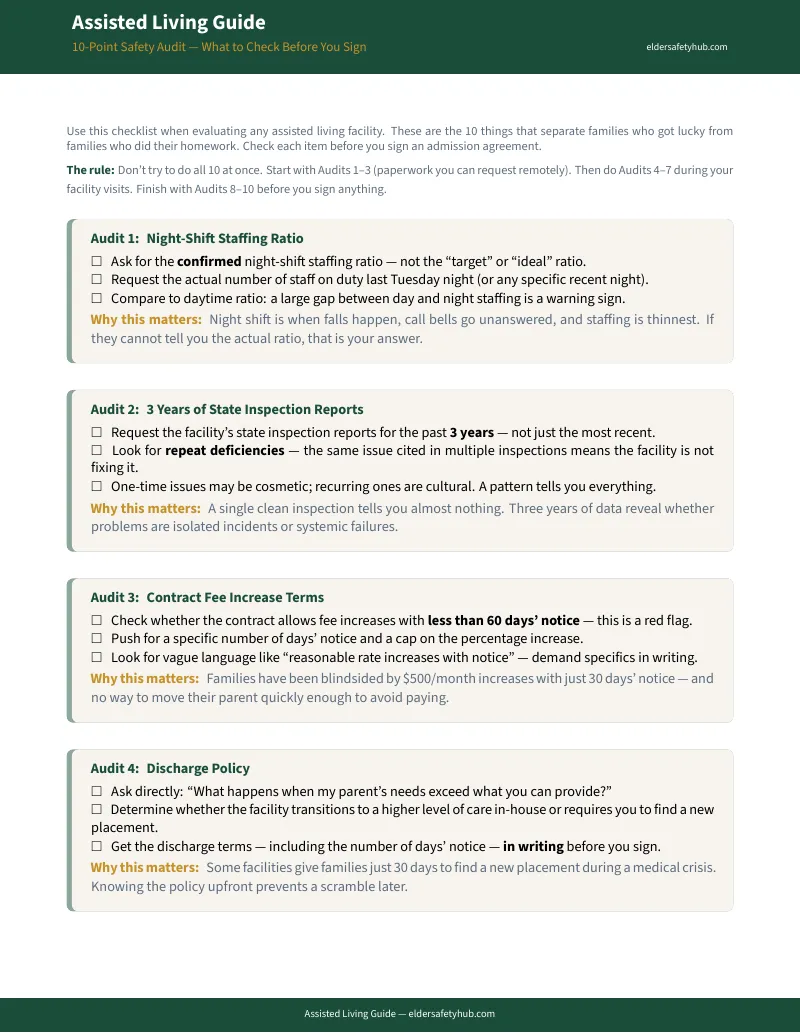
- Contract Audit Checklist — Because the clauses that cost families thousands are on page 9, not in the sales director's pitch. Community fees (non-refundable $2,000-$5,000 deposits), "level of care" pricing tiers that escalate within 30 days, involuntary discharge clauses for "behavioral issues" (a trap for dementia patients), bed-hold policies during hospitalizations, and arbitration clauses that strip your right to legal recourse. Know what to negotiate before you sign.
- Conversation Scripts for Resistant Parents — Because "You need to move" is how you start a fight, not a conversation. Three field-tested scripts for the hardest talk in caregiving. The "Safety" script reframes the move as protection. The "Partnership" script positions you as their advocate, not their authority. The "Trial Stay" script uses respite care as a low-commitment introduction. You can't force the decision — but you can change how it's framed.
- Tour Question Checklist — Because the sales director's job is to show you the dining room, not the night-shift staffing numbers. Night-shift staff-to-resident ratios. Medication error rates. Staff turnover percentage. Fall protocols and ambulance call policies. Elopement procedures for memory care. Whether telehealth visits are supported in-room. Print and bring to every tour — the answers separate the safe facilities from the ones relying on their chandelier lobby to close the deal.
- Sibling Alignment Worksheet — Because one sibling carries the burden while the other says "Mom seems fine to me." A structured tool to document care needs, share responsibilities, and resolve disagreements with data instead of emotion. Includes a role assignment matrix — who handles finances, who manages medical, who handles the logistics of the move — so the default caregiver isn't the only one making calls at midnight.
- Hidden Fee Comparison Table — Because the base rate on the brochure is a marketing number, not a real number. Side-by-side worksheet to map the true monthly cost of each facility: base rate + medication management fees + incontinence surcharges + tray service charges + care-level add-ons + community fees amortized. A $5,500/month facility quietly becomes $7,200 once acuity fees kick in. This worksheet shows you the real number before you sign.
- Emergency Contact Sheet — Because when your parent is rushed to the ER at 2 AM, nobody should be scrambling through a phone to find their cardiologist's number. One-page printable with fields for resident information, family contacts, medical providers, allergies, blood type, and DNR status. Print copies for the facility, each sibling, and the refrigerator at home.
- Country-Specific Regulatory Guides — Because every country hides its inspection data in a different bureaucratic maze. How to find and interpret official inspection reports: US state licensing databases and CMS five-star ratings. UK CQC reports and what "Requires Improvement" actually means. Canada's RHRA public register (Ontario) and Assisted Living Registry (BC). Australia's Aged Care Star Ratings and the new care-minutes mandates. New Zealand Health NZ certification audits and Corrective Action Requests.
- Financial Navigation Worksheets — Because the funding systems that could save your family thousands are buried in government jargon nobody explains. Country-specific guides: US Medicaid waivers, Veterans Aid & Attendance, bridge loans, and medical expense tax deductions. UK means-testing thresholds, Deferred Payment Agreements, and Attendance Allowance. Canada provincial tax credits and the public-vs-private cost bridge. Australia RAD vs. DAP comparison calculator and the new 2% retention rule. New Zealand Residential Care Subsidy thresholds and interest-free care loans.
- The Transition Checklist — Because placement day isn't the end — it's where most families stop preparing and most problems start. The logistics of the move: downsizing, what to bring, digital account security (passwords, banking access, mail forwarding), the first-90-days adjustment timeline, and the advocacy escalation path if care standards fail post-move (Ombudsman programs, regulatory complaints, rights of residents).
After Using This Guide, You'll Be Able To:
- Objectively assess whether your parent needs assisted living — using the same ADL/IADL framework that geriatric professionals use, producing a score you can share with siblings and doctors
- Tour facilities like an inspector, not a customer — with a printed question checklist that exposes staffing gaps, safety risks, and financial traps the marketing team won't mention
- Compare facilities on data, not feelings — using a weighted scorecard that produces a single number per facility so you can make a rational choice under emotional pressure
- Read a facility contract and identify the clauses that cost families thousands — community fees, care-level escalation, eviction triggers, and arbitration waivers
- Have the conversation with a resistant parent using scripts that reframe the move as safety and partnership, not abandonment
- Align siblings around a shared plan with documented responsibilities, so one person doesn't carry the entire emotional and logistical burden
- Calculate the true cost of each facility — not the base rate on the brochure, but the all-in monthly number after hidden fees
- Navigate your country's specific funding system — whether that's Medicaid waivers, CQC reports, RAD vs. DAP decisions, or the NZ Residential Care Subsidy
Why Not "Free" Referral Sites, Government Databases, or a $5 Etsy Checklist
A Place for Mom and Caring.com market themselves as "free advisors." What they don't mention: they charge participating facilities $4,000 to $6,000 per referral. They only recommend communities that pay commissions — which means smaller, often excellent board-and-care homes with 6 residents and a 1:3 staffing ratio never appear on their lists. A Washington Post investigation found that over 30% of A Place for Mom's "Best of Senior Living" award winners had serious regulatory violations, including neglect and substandard care. The "free advice" isn't free — you pay for it in biased recommendations, higher facility fees, and your phone number sold to every sales director in your zip code.
Government databases (Medicare.gov, CQC, My Aged Care) are unbiased — but almost unusable in a crisis. Medicare.gov only rates nursing homes, not assisted living, which is regulated state by state with no single federal database. State licensing portals bury inspection results behind codes like "Tag F689" and "Tag F600" that require a decoder ring to interpret. They give you raw data without telling you which questions to ask, which fees to watch for, or which contract clauses to negotiate.
Etsy checklists look beautiful and ask questions like "Is the facility clean?" and "Is the staff friendly?" The Placement Protection System asks "What is the confirmed night-shift staffing ratio, and how does it compare to the day shift?" and "Does the contract include involuntary discharge for behavioral issues, and what constitutes a trigger?" One is a decorative PDF. The other protects your family from a $70,000-per-year mistake.
This guide is , instant download, and printable. Print the facility scorecard before the tour. Bring the tour questions checklist in your bag. Hand the sibling worksheet to your brother who thinks Mom is fine. Sit at the kitchen table with the contract audit and go through it clause by clause before you sign anything. The format is the feature — it turns a paralyzing crisis into a manageable project.
The Wrong Facility Costs $70,000/Year. This Guide Costs .
Choose the wrong facility and your parent may face neglect, hidden fees, or a contract that allows eviction when her needs increase. Move her again — another $5,000 in community fees, the trauma of relocation, and the guilt of a decision you could have gotten right the first time. These are the stakes. And the current system expects you to navigate them using a facility's own brochure and a "free" advisor who earns $4,000 to put your parent in their client's building.
The best time to get this guide is before the crisis. Before the hospital discharge deadline. Before the facility tour. When you can sit down, read the scorecards, and make a decision from a position of preparation — not panic.
— Less Than One Hour of Your Time at Work
Compare it to:
- A Geriatric Care Manager consultation: $150-$200/hour
- A "free" referral service: $0 to you, $4,000+ from the facility — paid from budgets that could fund your parent's care
- A non-refundable community fee at the wrong facility: $2,000-$5,000
- A year at a facility you chose in a panic: $70,000+ and the cost of relocating again
30-day money-back guarantee. If this guide doesn't give you the clarity and confidence to evaluate assisted living options for your parent, you pay nothing.
This guide is an educational resource for families navigating senior care transitions. It is not medical, legal, or financial advice. Always verify current regulations through your country's official care quality body and consult with qualified professionals for decisions about specific care arrangements.
Every week without a plan is another week of guessing — and hospital discharge deadlines don't wait. Get the Assisted Living Guide now and turn the most stressful decision of your parent's care into a structured, documented, family project.